
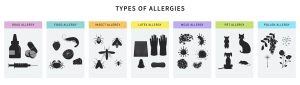
 Allergy types concept for infographic. Food, animal hair, latex, drugs, insect, pollen allergy. Poster, banner template with different allergens[/caption]
Why do some individuals develop allergy?
Many individuals have a genetic tendency to develop allergic diseases called as atopy. When atopic individuals are exposed to allergens they develop immune reactions against the allergen. During the allergic reaction antibody response occurs. These antibodies attach themselves to mast cells which respond by releasing a chemical known as histamine. Histamine leads to inflammation (redness and sweliing) causing allergic reaction.
Which organs can be involved in allergy?
Allergy can cause symptoms in the nose causing allergic rhinitis (hay fever), eyes resulting in allergic conjunctivitis, skin resulting in eczema, or hives (urticaria) and lungs resulting in asthma.
Allergy types concept for infographic. Food, animal hair, latex, drugs, insect, pollen allergy. Poster, banner template with different allergens[/caption]
Why do some individuals develop allergy?
Many individuals have a genetic tendency to develop allergic diseases called as atopy. When atopic individuals are exposed to allergens they develop immune reactions against the allergen. During the allergic reaction antibody response occurs. These antibodies attach themselves to mast cells which respond by releasing a chemical known as histamine. Histamine leads to inflammation (redness and sweliing) causing allergic reaction.
Which organs can be involved in allergy?
Allergy can cause symptoms in the nose causing allergic rhinitis (hay fever), eyes resulting in allergic conjunctivitis, skin resulting in eczema, or hives (urticaria) and lungs resulting in asthma.
 How do allergies progress over time?
The allergic diseases evolve over time with atopic dermatitis or eczema being the earliest and seen in infants. Food allergies are the next to appear over 1-3 years of age. Recurrent wheezing or asthma starts around 3-4 years of age and nasal allergies or allergic rhinitis appears around 5-6 years of age. The progression of these allergies is called as Atopic March. The timing of appearance of these allergies can be variable amongst children. All children may not get all the allergies but might get one or two. Allergic problems are more common in children where the parents or grandparents have allergies, although allergies can be seen in children without any family background of allergies.
How do allergies progress over time?
The allergic diseases evolve over time with atopic dermatitis or eczema being the earliest and seen in infants. Food allergies are the next to appear over 1-3 years of age. Recurrent wheezing or asthma starts around 3-4 years of age and nasal allergies or allergic rhinitis appears around 5-6 years of age. The progression of these allergies is called as Atopic March. The timing of appearance of these allergies can be variable amongst children. All children may not get all the allergies but might get one or two. Allergic problems are more common in children where the parents or grandparents have allergies, although allergies can be seen in children without any family background of allergies.
Atopic dermatitis or commonly called as atopic eczema is a condition where the skin of the child turns red and itchy. It is commonly seen in infants and young children but in some it can persist even up to teenage and later years of life.
The most common feature of atopic dermatitis is a dry itchy skin. Because of constant itching the skin can get thickened, cracked and scaly. The skin can get red to brownish-gray patches or small, raised bumpy areas which leak fluid and get crusted (image 1). The common areas to be involved are the hands, feet, ankles, wrists, neck, upper chest, eyelids, inside the bend of elbows/knees, and in infants, the face and scalp as shown in the image 2.


Children with atopic dermatitis can have times when the skin turns red, hot, burning, crusted or “weepy” and more itchy. These phases are called as flares. They are similar to asthma attacks in children. The areas in the body which are more prone to flares are the hands, feets, back of elbows/knees and neck.
In some children atopic dermatitis and food allergies are related. In children with severe infantile eczema and poor response allergy to milk and egg should be considered.
The two basic principles are avoiding skin irritants and keeping skin well hydrated.
Avoid things that irritate your baby’s skin, such as: strong soaps, perfumes, woolen clothing directly on skin, sudden changes of temperature and excessive sweating (image 3)


Make your baby bathe in luke warm water with a very mild soap or a non-soap cleanser as described in image 4. After bath, gently pat skin dry (avoid rubbing the skin) to keep it moist or slightly wet. Apply moisturizer right away on the wet skin to retain the moisture. This is called as ‘Soak and Seal Technique’ as shown in image 5.

During times of flares the child would need a steroid cream to be applied in addition to the moisturizer. Remember that their are many types of steroids available ranging from very mildly potent to super potent. Milder steroids are used for face which moderate are preferred for the rest of the body. This needs to be decided by your doctor.

The most common complication of atopic eczema is a bacterial skin infection. Children with atopic eczema have a cracked and broken skin. This increase the risk of the skin getting infected with bacteria. With superadded bacterial infections the skin becomes more red, hot, swollen, sore and develops oozing of pus. Early treatment with topic or oral antibiotic is required in such situations. Bleach baths can be quite helpful in children getting frequent skin infections (image 6)
The other common complications are viral skin infections such as herpes viral infections. Apart form these various other complications are seen such as sleeping problem because of excessive itching, poor self confidence, psycological issues and bullying in school.
This is a written one-page document which provides key information on how to treat your child as the eczema changes. It provides information on the daily bathing advice and moisturizer to be used, what to do when their is a flare and when to consult your doctor. Every child with atopic eczema should have an eczema action plan!
What is urticaria in children?
Urticaria, also commonly called as hives, is a condition in children where many red, itchy, bumpy and swollen areas appears on the skin. The size of the hives can be variable from very small to very large. They can involve any part of the body. Hives go away usually in a day but comes back in a different place. Sometimes, in addition the mucous membranes like tongue and lips also get swollen.

What causes urticaria?
The commonest cause of childhood urticaria is viral infection. Usually the child gets a cough and cold with or without fever and accompanying this or a few days later the child develops hives. This urticaria is not mediated by allergy.
Urticaria can also happen secondary to food allergies. The common food allergies in children are to egg, milk, soy, peanut and tree nuts. The third common cause is certain medicines like pain killers, antibiotics, medicines for epilepsy etc. Sometimes the cause of urticaria may be unknown.
Other causes of hives could be exposure to cold, post exercise, etc.
What is Chronic Urticaria?
Urticaria usually lasts for a short duration of 3-5 days. Sometimes, urticaria persists for more than six weeks and this is called as chronic urticaria. Chronic urticaria in children is usually idiopathic (no cause can be found), but occasionally could be secondary to some physical stimuli. These situations are described as chronic inducible urticaria.
What are the causes of chronic inducible urticaria in children?
Chronic inducible urticaria can be induced by specific physical or environmental stimuli (cold, heat, exercise, pressure, sunlight, vibration, water, etc.).
How is urticaria in children treated?
The treatment of acute urticaria is an anti histamine like cetirizine or similar for 5-7 days. The triggers, if any identified like food or drugs should be strictly avoided.
Children with chronic urticaria require long term anti-histamines medicines. Some children who do not respond to anti-histamines might require additional medicines like cyclosporin or omalizumab.